


A board game player on Reddit described opening Dune. The box held several individually wrapped stacks of cards. The film was tight and there was no tab to grip, so the player pulled the film away from the edge and used a knife, careful not to mark the cards. Opening all the card packs took about 20 minutes, according to the post. Reddit discussion
A snug wrap has its benefits. It keeps a stack together and lets several stacks fit neatly in a box. At Zhongfu, we look at how a stack is held and how someone opens it as two separate questions. Giving fingers something to grip does not mean making the whole pack loose.
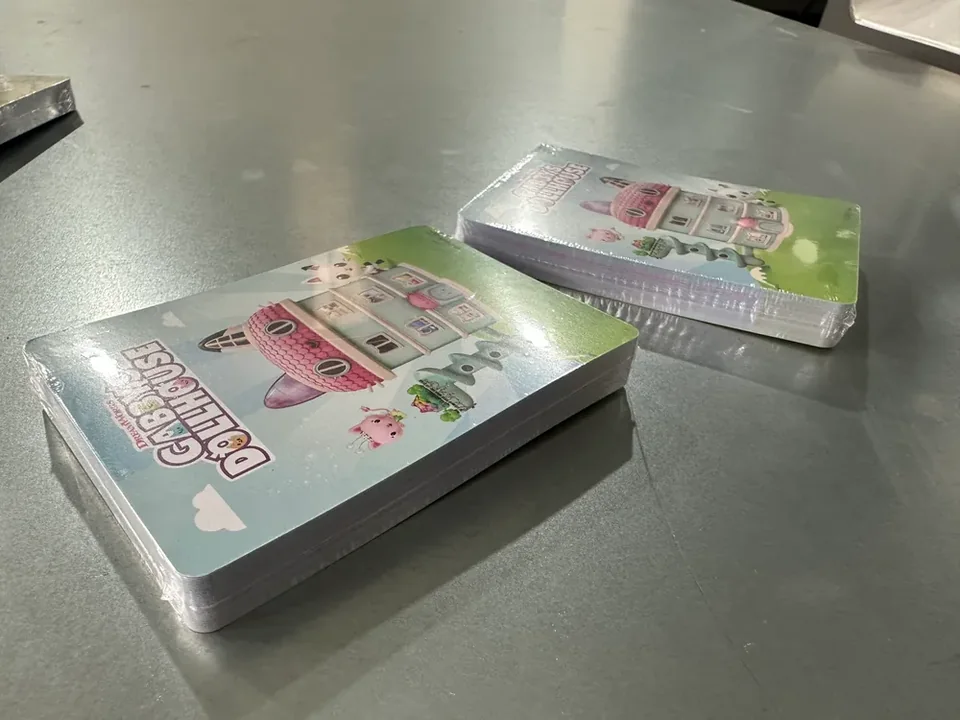
A close-fitting shrink wrap can still have a pull tab
When several decks share one box, shrink film follows the outline of each stack without leaving broad bag ends. In one card-packaging trial, Zhongfu used a GS500 high-speed reciprocating sealer with a shrink tunnel and recorded 120 card packs per minute. This was the result of that trial, not a finished-box rate, a sustained-output guarantee, or a measured rate with easy-open or security film. GS500 reciprocating sealer
To keep the close-fitting finish, we can match the easy-open film and opening feature to the equipment. A tear strip with a pull tab is one example. The detail we pay attention to is whether the tab is still easy to see and grip after the film has shrunk. A good opening gives players a place to start without bringing a blade near the edge of a card.
A flow-wrapped bag can be easy to open too
With Zhongfu’s horizontal flow wrapper, an aligned stack goes into formed film and is sealed as an individual bag without passing through a shrink tunnel. The bag has end seals and a different finish from conforming shrink film. With compatible film and opening features, we can put an easy-open notch where fingers can reach it. An ordinary end seal is not an easy-open feature on its own. The difference between the two methods is the type of pack they produce, not whether it can be opened by hand. Card and printed-product packaging solutions
Easy opening and authentication can share a pack
Both methods can use a suitable film with security features. On a shrink pack we look at whether the feature stays legible after shrinking. On a flow-wrapped bag we look at whether the print stays clear of the seals and the cut. Some films cannot simply be swapped into an existing machine, so we consider the film, opening feature and machine configuration together.
An easy opening shows where to start a tear. Tamper evidence can show signs that a pack may have been opened. Authentication depends on a feature a customer can actually verify. A clear-looking seal or a printed brand logo by itself does not prove the cards are genuine.
From individual card packs to a complete boxed game
A game box can hold several different card packs. Once each stack is wrapped, the right types and quantities have to come together and go into their places in the box. After the lid is closed, the finished box can go through an outer film sealer and shrink tunnel if the product calls for an overwrap.
Zhongfu can design deck wrapping, set assembly and box loading, and outer shrink wrapping as one line. At the front, we can use either close-fitting shrink wrap or individual flow-wrapped bags. In the middle, we plan how the streams of card packs come together and reach the loading station. At the end, the closed boxes move into outer wrapping. If an existing box-loading station matches the way packs are transferred and the line speed, we can consider keeping it and connecting the conveyors and wrapping equipment around it.
Inner and outer film do different jobs. Inside the box, players want the decks kept separate and easy to open. On the shelf, the outer wrap can support the appearance of the finished box and carry tamper-evident or security features. Not every game needs both layers.
120 card packs per minute is not 120 finished boxes per minute. How many packs belong in each box, how consistently the different packs arrive, and whether loading and outer wrapping can keep up all affect the final rate. Designing the stages together is how we turn several wrapped packs into one neatly finished box that is easy to open and ready to play.
Watch Zhongfu's card feeding and wrapping demonstration
The video shows card feeding and film wrapping. It does not show the complete boxing line.