

Industrial roll & large-product packaging solutions
Compare roll-support and large-pack transfer routes, with wrapping selected around load, surface coverage and the required finish.
Planning your packaging project
Products and packs. Industrial rolls and large products that need protective covering. Weight, shape and the support available during transfer affect the layout.
Equipment to consider. View relevant equipment. Review large-format sleeve wrapping where it suits the load. Use a handling and film trial for the largest representative product.
What to send for a quote. Largest and smallest dimensions, weight, support points, required film coverage and upstream and downstream transfer heights.
Packaging process
For industrial rolls, large products, cartons and grouped industrial packs
All routes shown.
Present the industrial roll
Define the roll diameter, length, weight and incoming orientation. The required wrap may concern the outside surface, the ends or both; describe that coverage before selecting a wrapping method.
Equipment typeExisting roll feed or loading arrangement
Support and orient the roll
Arrange support and transfer around the roll shape and weight. Agree which orientation is needed at wrapping and which contact areas can be used. Existing handling may remain part of the process.
Equipment typeRoll-specific support and transfer
Present the large product or carton
Define the complete pack dimensions, weight and the arrangement if products are grouped. A carton or large product arrives in the condition needed for outer wrapping; loading and product assembly can remain upstream.
Equipment typeExisting product or carton feed
Support and space the large pack
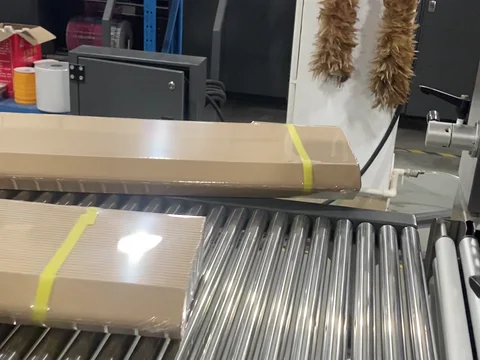
Review the support surface, clearances and stability through transfer. Grouped products need their arrangement maintained before and after wrapping. Select loading, spacing and conveying around the actual load rather than scaling a small-pack layout.
Equipment typeLoad support, guides and conveying
Wrap to the coverage you need
Discuss side-sealing or sleeve-wrapping equipment around the required surface and end coverage, product shape and finished pack. Select the film and actual machine configuration with product samples and the load-support arrangement.
Equipment typeSide sealer or sleeve wrapping machine
Add shrinking only where selected
Include a shrink stage only when the film, product and desired finish call for it. Review the load envelope, materials and heat exposure as part of the sample and layout assessment. A non-shrink wrap follows the bypass route.
Equipment typeShrink stage where specified
Transfer the wrapped load
Check film coverage and pack stability before the next transfer. Where heat shrinking is used, allow the pack to cool as needed. Match outfeed support and the downstream interface to the finished load and its orientation.
Equipment typePack check and load-supporting outfeed
Choose the dispatch stages
Retain manual or existing dispatch handling, or discuss selected labeling, case or pallet handling. Agree the supplied interfaces and site space without assuming that the whole line must be replaced.
Equipment typeSelected downstream handling and interfaces
Define the coverage and transfer
Start with the load and the coverage it needs. Roll-shaped products and large cartons may require different support, orientation and wrapping configurations.
- Load: product or roll dimensions, weight, incoming orientation and grouped-pack arrangement.
- Coverage: which surfaces or ends need wrapping, required openings, film type and target finish.
- Transfer: permitted contact areas, support, spacing, height and existing upstream or downstream equipment.
- Site and scope: required output, size changes, available space and the dispatch stages you want to retain.
Packaging examples